There's a story about Jack Kirby. During the 70's, he apparently worked sporadically on a novel entitled The Horde. Not a whole lot is known about The Horde except that it involved a kind of modern ay Genghis Khan emerging from Asia and waging war against the world. The story goes that Jack stopped working on The Horde because he was scaring himself. He would read the morning paper, or watch the evening news, and see the fictional events he was describing coming to pass in the real world.
Others have noted that Kirby's 70's work has turned out to be surprisingly prescient. Maybe this isn't really so surprising - Jack was an unusually forward-thinking guy who believed in technology - and the human heart - and believed they would guide us, hopefully, into a positive future.
That kind of prescience isn't the result of magic. Merely logic + imagination. But, having said that, picking up "Madbomb" in late August 2019, I find myself in the midst of a story that's prescient in some very disturbing ways. And it's scaring the hell out of me.
"Madbomb" ran in Captain America (and the Falcon) issues 193-200, roughly October 1975 to May 1976, beginning on the eve of the Bicentennial (anyone else out there remember that?). It was the first new work Kirby had done for Marvel in 5 years. Although he was welcomed back as a hero, many didn't like Kirby's new stories, or his more extreme art style. I've written about this elsewhere. Another grump some fans had was that Kirby pretty much did away with any continuity with Steve Englehart's long run on Captain America. Englehart's run had been marked by some decidedly subversive themes, with Cap even abandoning the Captain America identity for a time, due to his disgust with Nixon-era America.
Kirby's take on Cap was different. This Captain America would never turn his back on the patriotic symbols that defined him. That might have seemed corny in 1975-1976. But the truth is, what Kirby was up to may have been a lot more subversive than anything Englehart had ever imagined.

"Madbomb" starts with Cap and the Falcon being caught in a riot in the streets of New York. This leads to a briefing by no less than then-Secretary-of-State Henry Kissinger(!). It seems this riot was set off by a curious bit of technology called a "madbomb" - a device that blankets an area with sonic waves, causing anyone in range to turn into a homicidal maniac. SHIELD has discovered that whoever is using these weapons has developed one large enough to blanket the entire US. Dispatched to some remote region of the country, where several SHIELD agents have disappeared, Cap and the Falc find themselves captured by something called The Royalist Forces of America, and forced to participate in brutal gladiatorial games.
The Royalists are a cabal of fabulously wealthy men planning to unravel American democracy, and replace it with an aristocracy - "men born to be served, who live(d) above the common rabble!"led by a grump named Taurey (in case we missed the joke, his partner is named "Heshin").
The gladiatorial games are witnessed by an unruly mob, completely in thrall to a simulated image of a non-existent leader who exhorts them into a frenzy. They also encounter the selfish, ruthless, and stupid daughter of a Royalist leader, Cheer Chadwick, who provides some exceedingly grim comic relief.
Landing in the midst of all of this is possibly the strangest Kirby story ever published. "Captain America's Love Affair" is such a bizarre detour it stands out as odd even in the often odd world of Jack Kirby. It's also one of the best Kirby comics ever published.
Having rounded up the rank-and-file of the Royalists, Cap, Falc, SHIELD and the US army are still searching for the full-size madbomb. And they've found a clue in the actions of Mason Harding, a brilliant scientist who's been missing for two years, but now seems to be making appearances at an isolated mansion on the east coast. On a spying mission, Cap discovers the reason for Harding's visits: his daughter Carol, recovering from an unnamed illness, is convalescing at the mansion, where she's kept largely under wraps. Figuring the most humane way to keep her safe while SHIELD raids the house, he arranges a rendezvous with her on the beach. This quiet and thoughtful interlude alternates with scenes of solid Kirby panel-busting action as Falcon and SHIELD tear the place apart, leading to Harding's capture and confession (Harding has been blackmailed into developing the madbomb) and, of course, a final confrontation with Taurey and the Royalist leaders.

"Madbomb" has the usual Kirby problems - stilted dialog, corny monologues by Cap and the Falcon (his attempt to write hip lingo for the Falcon is particularly awkward), odd and not always logical plotting. And when I first re-read it a couple decades ago, I found the notion of the Royalists a bit silly. Why would anyone want to re-install a European style, 18th century model aristocracy? Besides, plutocrats have been gaming the American system since Day 1.
To sit here in 2019 and read the "Madbomb" stories, while watching on the news as our own US president, and allies in congress, openly flaunt not only social norms but the very laws that have held our fragile system together all these years... it's well-nigh impossible not to see the shadow of Trump and his hideous children, the Koch brothers attempts to bankroll a system that guarantees only more wealth and privilege for people like themselves, aided and abetted by the Mitch McConnells, Paul Ryans, and Mitt Romneys and all the other 1% clowns, willfully tossing aside the very laws and values their alleged patriotism is supposes to support. It's hard not to see the image of the Trump offspring in Cheer Chadwick, or the fired-up "crowds" at Trump rallies in the chaotic audience of at the Royalists gladiatorial games.

Kirby grew up poor in Jewish ghetto. A member of "the greatest generation", he served as a scout in WWII. In later years, he spoke proudly of Leon Klinghoffer, a childhood friend, who stood up to terrorists in the Achille Lauro incident in 1985 (and died for it). He believed in those values that Cap was supposed to symbolize. And he understood how easily they could be taken away. Re-reading "Madbomb" today, I don't find it silly. I find it all too prescient.
Summer 1977 was a good time for fantasy. Star Wars had fired everyone's imagination, of course. NBC was preparing to air an animated adaptation of Tolkein's The Hobbit, while animator Ralph Bakshi had earlier that year released the odd Wizards, and was busy at work on an even more ambitious project, Lord of the Rings itself. A strange game called Dungeons and Dragons was turning up increasingly in toy stores, and getting a fair bit of buzz, though no one seemed to know much about it or how it was actually played. Meanwhile the sci-fi section of bookstores was groaning with Elric, Conan, and other sword-wielding heroes; Conan still stalked the comics racks, and DC had recently tried a slew of fantasy titles (of which only The Warlord was still in action). Into this world of elves, dwarves, magicians, swords and monsters, Marvel started giving the heavy push that summer to the upcoming Marvel Premiere #38: "Weirdworld".
An aside: Marvel Premiere and its sibling title Marvel Spotlight were "tryout" books. A character or series might get one, or several issues, to see if sales justified giving the series/character their own book. A few made it. Many did not.
Being very interested in fantasy anway, I had fully intended on buying the issue, should the opportunity arise. And, arise it did, one hot night at 7-11. There it was, on the rack, looking even more awesome than expected - snake-monster looming over a pair of diminutive, elfin figures. "For those who thrilled to J.R.R. Tolkein's Lord of the Rings, an all-new adventure into EPIC FANTASY!" shouted the cover. Good enough!
You ever have one of those experiences, where something you thought would probably be good turns out to be ever better than you'd hoped? So it was with Weirdworld. That issue of Marvel Premiere immediately became, and remains to this day, one of my favorite comics.
The story (which is actually titled "The Lord of Tyndall's Quest") tells of Tyndall, an elf - not an Orlando Bloom elf, but rather a small, slender, pointy-eared and childlike figure, who has been sent forth from a community of dwarves - more the Disney variety than the John Rhys Davies kind, I might add - alone, with a sword, into a place called The Region of Shadow, a monster-haunted wilderness, to destroy something called "The Heart of Evil". Tyndall isn't even sure what the Heart is, or how to destroy it, but he doesn't see a lot of options.
There, in the skeletal remains of some giant monster, Tyndall finds a large glowing egg, which he assumes is The Heart of Evil. To his surprise, the egg hatches. To his even greater surprise, it hatches a full-grown elf girl named Velanna. Tyndall realizes the whole thing had been a set-up. It was either intended that he'd kill Velanna, or die in the attempt, and either way, there'd be no more elves (Tyndall and Velanna seem to be the only elves in the world). Together, he and Velanna set out to find a home for themselves.
They are almost immediately captured by Grithstane, a wizened, evil old wizard. Grithstane has an elf-girl chained up in his caverns, with whom he wants to make elf-whoopie, but is incapable, since she has no interest in making it with his ancient, decrepit self. He needs the blood of a dragon, and thus, holding Velanna hostage, sends Tyndall of to Klarn, a floating, ring-shaped island in the sky, to get some. On Klarn (which happens to be Tyndall's apparent point of origin, but of which he knows nothing), Tyndall fights some troglodytic tribesmen, another elf-girl who changes into a swamp serpent (giant swamp snakes, a sample of which is shown on the issues' cover), and finally a dragon. Returning to Grithstane's, he finds the captive elf-girl had some dark secrets of her own...

Weirdworld was drawn by Mike Ploog, my favorite 70's Marvel artist. Ploog did lots of great things, but this may well be my favorite (if it isn't, then his issues of Frankenstein are). Owing more to Ghastly Graham Ingels and (especially) Will Eisner, Ploog's stuff was pure otherworldy fantasy; elegant, dark, funny and scary - often all at the same time. It's one of the most beautiful comics Marvel published in the 70's.
The author was Doug Moench. Moench was one of comics' warhorses in the 70's, starting out writing horror stories for Warren's Creepy and Eerie, then rolling into Marvel where he knocked out a slew of titles, most notably Deathlok and Master of Kung Fu. He was always reliably good and occasionally excellent (particular note goes to his part in the Batman "Knightfall" cross-over series in the 90's). Weirdworld was special, though. Moench really seemed to put his heart into this and it showed. There was simply nothing else quite like it around at the time.
I loved that comic and read it again and again, and waited fervently, hoping Weirdworld would get spun off into its own series.
It took awhile. But about a year or so later, Marvel announced, not a new regular book, but a magazine-size Weirdworld miniseries, to be titled Warriors of the Shadow Realm. What's more, Warriors was to be a bold experiment, with artwork that was not merely colored line drawings, but actual painted color process. This held the potential to be spectacular stuff. One disappointment though; Ploog was no longer working for Marvel. Drawing chores were to be taken by John Buscema. Buscema was a fine and legendary artist who'd done some excellent stuff when he first came to Marvel in the late 60's, but by the 70's he was largely hacking it out. Still, the one-panel sample which appeared in Starlog looked pretty great.

Well, Warriors arrived in the early summer of `79 and, if it wasn't quite the spectacular Marvel had promised (when did that ever happen?), it was still a gorgeous piece of work that looks even better today. Buscema might have been phoning in Conan et al, but he brought his A-game here. What's more, he showed a side we'd never seen before. Despite a few standard Buscema faces (Big John had a limited bag of tricks), the art owed less to Jack Kirby and a lot to Arthur Rackham. Rudy Nebres' inks brought out the best in it, and Peter Ledger's airbrushed and painted coloring was a wonder to behold. Warriors had a different feel than Ploog's work, but it was stunning in its own right.

The story, though much more ambitious than "Tyndall's Quest", still retained the fairy-tale charm that had made the original so special, with Tyndall, Velanna, and their new companion, a cranky, hedonistic dwarf called Mud-butt (if he had a real name, it was never given) moving into a much larger and more dangerous world, and battened by forces (in this case, more evil wizards and demi-gods) way beyond their comprehension. Adding in features such as a lengthy essay by Moench on the origins and intentions of Weirdworld (in which it was revealed that there had actually been one earlier Weirdworld story, a short-short titled "An Ugly Mirror On Weirdworld", which was written in `73 but did not see print till three years later, when it showed up as filler in Marvel Super Action #1, a b&w mag devoted primarily to reactionary "superhero" The Punisher), behind-the-scenes features and a couple of lengthy and informative articles on fantasy in art, the three issues of Warriors of the Shadow Realm were a real highlight of the summer of `79, and some of the best mags Marvel ever produced.
Despite some good reaction (I guess) and many promises, Weirdworld then lay dormant for nearly three years, before finally reappearing in the pages of Epic Illustrated, Marvel's early 80's attempt to compete with Heavy Metal.
"The Dragonmasters of Klarn", a 4-part serial, couldn't compete with Warriors for sheer artistic grace - mainly because Marie Severin's inks didn't reproduce well (I've seen shots of the b&w originals and they look terrific, and Marie was one of the all-time greats), and Steve Oliff's paintings just couldn't compete with Peter Ledger's glorious colorfests. Still, the story maintained the tone of the earlier tales, which was what made them special, and even managed to advance it a bit: Velanna, under the influence of an(other) evil magicians' spell, turns into a cold-hearted bitch, while a hurt and confused Tyndall is forced to finally graduate from brave boy to courageous man, and learns something about himself in the process. All in all, it was a worthy next chapter.
After that, Weirdwold wasn't seen again for several years. In 1986, a partially completed first third of a three-part story - "The Weremen of Lord Raven", originally started by Ploog and Moench in 1979, before Warriors of the Shadow Realm, was dusted off. Pat Broderick worked up the final two installments from Moench's script. This story pre-dated Warriors, and in fact told of Tyndall and Velanna's first meeting with Mud-butt. The story was still a winner, but Ploog's art on part 1 was less polished than his other works, and Broderick's work on the remainder of the story lacked the luster of Ploog or Buscema's art. It was still Weirdworld. By then Moench had fallen out with Marvel and was over at DC, working on Batman. Weirdworld as we know it was never seen again.

In the first issue of Warriors, Doug Moench told his own story of the genesis of Weirdworld, which, he says, came to him almost spontaneously, and owed more to the fairy tales of his childhood, and to Walt Disney ("an imaginary, unmade Disney film recalled from childhood - but existing only in my mind") than to Tolkein. He also recounts the difficulties he had getting those first two stories published and placed. It's doubtful that many saw "An Ugly Mirror on Weirdworld", or that many Punisher fans would have considered it anything but stupid, so the Marvel Premiere had to have been a labor of love. It also must have done pretty well, for Marvel to take on such a costly and risky project as Warriors of the Shadow Realm. Based on the low-profile follow-ups, and long intervals between them, for Weirdworld, I'm guessing Warriors didn't exactly set the comics world on fire.
That's a shame, but maybe not a surprise. In Moench's own words, Weirdworld was always "...different... there was no real place for it in the market for which it was written. it simply did not belong." And that's probably true. Certainly it didn't fit the mold art-wise - Ploog or Buscema, it looked like nothing else out there. Even moreso, it didn't fit the mold character-wise. Tyndall and Velanna were small, slight, childlike, almost powerless, and hopelessly innocent and naïve. They didn't have much in common with Conan or Wolverine, after all. Stephen King once noted that the greatest fantasies are about characters who acquire power. The lesser ones are about characters who merely wield power. There's some truth in that, and that's very much the point of Weirdworld. Tyndall in particular becomes braver, more knowledgeable, and more confident as the stories progress. That's not what comics fans are used to. That, and their childlike appearance and demeanor may well have thrown off fans. And indeed, such characters risk becoming cloying. That never quite happens, but it was a close call sometimes. Initially, I found Mud-butt intrusive, but reading the stories now, its clear he brought a necessary edge of cynicism and humor to the proceedings.

If Weirdworld resembles anything out there in comics-land, its Richard and Wendy Pini's Elfquest, which also combined gorgeous art, fantasy, and childlike-looking characters. But Elfquest (which started appearing not long after that Marvel Premiere issue - I doubt that it was influenced by Weirdworld, but I'm sure the Pinis were aware of it) is still harder-edged, and far more epic in scope. Also the Pinis were self-publishing, and thus not at the mercy of a corporate entity with its eye one the bottom line.
Given the growth in popularity of fantasy, and Dungeons and Dragons, throughout the 80's, it's surprising to me that Marvel didn't give Weirdworld another try (apparently head honcho Jim Shooter did meet with the TSR people over a possible D&D comic, but nothing came of it). Then again, by 1983, Moench had bailed on Marvel, along with many of the other 70's-era gang, and it may simply be that Weirdworld no longer had a champion at the Bullpen. Perhaps, too, Weirdworld was too much of a personal project for Moench, who had been at loggerheads with Shooter, and Marvel didn't care to risk another lawsuit ala the infamous Howard the Duck debacle. Or all of the above. Interestingly, though he's been interviewed a number of times, Moench seems not to have said much of anything about Weirdworld. Perhaps its lack of acceptance was hurtful to him, or perhaps he simply moved on.
But I suppose, the story is told. Weirdworld is ultimately about Tyndall and Velanna's quest to find their place in the world. And if that isn't quite where it leaves off, the final Weirdworld story does a more mature, wiser and confident Tyndall, who's at least beginning to find answers.
In 2015, Marvel began another series titled Weirdworld. Alas, it had nothing to with this series.
Also in 2015, they published a paperback collection, Weirdworld: Warriors of the Shadow Realm, which collects all of the above and most of the extra features from the Warriors issues as well. It's a nice collection and great to have everything under one cover, but the artwork from Warriors is not well reproduced (smaller than its original print size, and darker), so if you're really interested I recommend picking up the original issues as well (they seem to go for between $5 and $10 apiece).
I've always had a soft spot for Ka-Zar, Marvel's Tarzan in Dinosaur-land, ever since I picked up a few issues as a kid.
Ka-Zar was, as I said above, basically Tarzan. With a twist. Instead of darkest Africa, he ran around in The Savage Land, an isolated lost world found in a remote part of Antarctica, with a tropical climate and a population of dinosaurs, prehistoric mammals, primitive tribesmen, and lost civilizations galore. Instead of a chimp, Ka-Zar palled around with a sabre-tooth tiger named Zabu. Okay truth be told, Ka-Zar himself wasn't all that interesting - just your basic macho-muscle-man. But the dinosaurs, lost civilizations and Zabu were more than enough for me when I was 8/9/10.

In early `81, Ka-Zar the Savage showed up on the racks over at Cosmic Comics, and, soft spot still very much in place, I grabbed it. Now, I had fully intended on adding Ka-Zar to my list of regular titles, cuz at 14 dinosaurs and a sabre-tooth tiger companion were still reasonable selling points for me. But by the time I had finished reading ish 1, there was no doubt in my mind. Because Ka-Zar the Savage was not only quite different from what I'd expected - it was quite different from any other comic I'd ever read.
To explain that, I have to back up a little and clarify what Ka-Zar had been, prior to 1981. KZ made his bow in X-Men #10 at the beginning of `65, in which the X-Men discover The Savage Land and take KZ for a possible mutant. He isn't. But they do find a place full of dinosaurs and neanderthalic cavemen. KZ initially fights them, then helps them rescue Jean Grey from being sacrificed to the cavemen's Tyrannosaur/god. It wasn't much of an issue, but it did feature dinosaurs, some great Kirby prehistoric vistas, and the bizarre vision of the X-Men and Tarzan-clone Ka-Zar fighting antediluvean beasties. As for Ka-Zar, he wasn't much, being mostly irascible and not very bright (most of his dialog consisted of lines like "Ka-Zar powerful! Ka-Zar strong! Ka-Zar mightiest of all!" etc). After that, he popped up every year or so, in Spider-Man, Daredevil, and The Hulk, and later a single issue of Marvel's first "tryout" book, Marvel Superheroes. Along the way he was given a back-story: KZ was actually Kevin Plunder, son of a rich British explorer, lost in The Savage Land after the death of his father, having grown up in the wild - all very Tarzan. It was also revealed that he was, in fact, intelligent and articulate - he just liked playing the role of a moronic savage. Okay....

In 1970, with Marvel expanding, KZ got a part in Astonishing Tales, a new "split" book (each issue contained one half-length story) which he shared with Dr. Doom, Marvel's #1 baddie ("now in his own series!"). His run there lasted 20 issues, with Dr. Doom being pushed out after issue 7. He then spun off into his own title, Ka-Zar, Lord of the Hidden Jungle which also lasted 20 issues. Just for good measure, he also had a series in the b&w magazine title, Savage Tales. These stories were marked by a more "mature" approach (translation - they had naked wimmen in them), but were otherwise mostly interchangeable with the stories running in AT and KZ. All of them suffered from the same problems: Ka-Zar had a fun setting, but wasn't a particularly interesting character himself. An even bigger problem: all of them suffered a revolving door of artists/writers. Some strong work was done by Jack Kirby, Gil Kane, Barry Smith and (especially) Russ Heath. Unfortunately, much uninspiring work was done by Herb Trimpe and John Buscema, who seemed uninterested, and, towards the end, some very ugly stuff by Val Mayerik. Story-wise, few seemed to know what to do with Ka-Zar, or care much. The stories remained pastiches of Robert E. Howard and Edgar Rice Burroughs, with Ka-Zar encountering a slew of lost civilizations, while fending off greedy scumbags who came to the Savage Land bent on exploitation. Periodically, when ideas ran out, they'd spirit him back to NYC, where he'd spend most of his time complaining about the loathesomeness of urban society. It was often fun to read, but never classic stuff,
After Lord of the Hidden Jungle bit the dust, KZ wasn't heard from much for several years, though he reappeared in a very memorable X-Men (#114-116) story set in the Savage Land (all in all, though, his role was small and the Savage Land setting was actually the more compelling element).
So, into all of this comes Ka-Zar the Savage.
The ish opens with Ka-Zar watching dispassionately while a pack of wolves brings down a wooly rhino. Instead of intervening, he ponders the futility of life in the Savage Land. This in and-of-itself is hardly a typical opening. Hearing a scream, he runs off to help (that's more like it), and finds Shanna (the She-Devil) (a minor, near-forgotten character from Marvel's brief attempt to net more female readers, Shanna was an NYC veterinarian who'd turned her back on civilization and gone full jungle queen - first in Africa and then later in the Savage Land - she'd made several guest appearances in the Savage Tales stories), recuing a dinowhatsis from a tar pit. Ka-Zar lends his shoulder, but all the while debates Shanna on the point of the whole thing, since the little dino will doubtless get eaten by a predator soon anyway. Huh?? This was not exactly expected hero behavior.
Shanna and Ka-Zar proceed to have a debate about their jungle lifestyles, and whether they're simply afraid to join civilization. Shanna ends the debate by throwing mud in KZ's face and letting him chase her into the jungle, where she quite willingly makes love to him.
Six pages, a third of the way in, and so far we've had philosophical debates and surprisingly explicit (though by no means graphic) sex. This comic was not following the normal script.
Ka-Zar heads off the next morning, in search of Zabu, who's gone missing (!!!). He soon finds himself in a previously unknown part of the Savage Land, where he finds a woman being molested by a bunch of primitive goons in animal skins (now things are returning to normal). However, instead of rushing in to help, he seriously considers minding his own business (WHAAAT??). He changes his tune once he gets a good look at her, and, since she's a hot number, he decides to rescue her. This kind of caddish behavior is definitely not the KZ we know and love.
The hot chick turns out to be Leanne, Queen of Zarhan, an "ivory metropolis of glistening crystal towers". Leanne it seems is out looking for her pet sabre-tooth, Felina, who's also gone missing. Figuring this might be a lead to Zabu, Ka-Zar agrees to help, even though Leanne tells him to his face that he's an imbecile. Ka-Zar and Leanne go looking for the village of the tribesmen, while KZ tries unsuccessfully to get Leanne to give him some. They find Felina about to be sacrificed, but a last-minute intervention by Zabu (and then Ka-Zar, who's still more interested in getting laid) saves the day. Seeing that Zabu and Felina are actually a couple (thus explaining their recent absence), Ka-Zar pledges his undying love to Leanne. She accepts, being as he's her hero now and all.
But the trip to Zarhan does not go well. Leanne, put off by KZ's barbarian ways, dumps him at the gate, telling him he could never fit into her ordered society. A disgusted Ka-Zar and a sated Zabu walk off into the distance.
Superficially there was a lot of standard Ka-Zar fare here. Lost civilization, primitive straw-men for KZ to knock over, dinosaur fight. But Ka-Zar's indifferent and cynical attitude, the sexual byplay, and the unexpected twist (Leanne might be a bitch, but she's actually right about KZ) was something very different indeed.
The new Ka-Zar was helmed by Bruce Jones, a relative newcomer to Marvel. Jones wasn't a superhero guy. His main project was helming Pacific Comics, a short-lived San Diego based publisher - Jones was publisher, editor-in-chief, and head writer on the EC homages Twisted Tales and Alien Worlds. His writings tended to feature adult emotional and sexual situations not usually seen in comics at the time. Marvel, indifferent to a title they were only publishing in order to preserve copywright, gave him a free hand. He used it.
The biggest change was Ka-Zar himself. Formerly mostly void of personality, he now had a distinctly unusual one for a superhero. Bored, sarcastic, and cynical, he seemed tired and burned-out - on himself, the Savage Land, the clichés of his old storylines. He'd wade into the inevitable dinosaur battles making wiseass remarks about the senselessness of the whole thing.
The centerpiece, though, was the relationship between KZ and Shanna. Endlessly debating, bickering, one-upping one another, blatantly sexual and decidedly tempestuous (allegedly Jones drew inspiration from his actual relationship - must've been a difficult one).
Jones upended the series, setting most of it not in the Savage Land, but in Pangea, another lost world, adjoin the Savage Land. Zabu came dangerously close to disappearing (Jones had a tendency to forget about him, and had to shoehorn him in after the editor reminded him that KZ had a loyal sidekick). Still, his appearances were usually memorable and, by way of making up to any frustrated Zabu fans, he even got a back-up series, "Tales Of Zabu", with surprisingly good art by the erratic Val Mayerik, which was pure retro and a lot of fun.
The stories poked fun at themselves and at comics in general, abounded with pop-cultural references, and took decidedly odd turns. One story arc involved discovering the all-too-real origins of Dante's Inferno. One issue was devoted to analyzing a nightmare. Another involved the use of hallucinogenics, and diverted into film noir fantasy, with Shanna turning into a springbok(!). Another dealt with the death of Tongah, KZ's long-time bosom buddy from back in the 70's. It might be stretching things to call Tongah a beloved character, but his demise was genuinely tragic.

For all that, Ka-Zar the Savage's heyday was fairly short. After the first dozen or so issues, things began to get a bit stale. The constant bickering between Shanna and Ka-Zar was starting to become tiresome. Even moreso was their constant two-timing. Ka-Zar fell stupidly into relationships with Leanne (see above), a bird-woman, and Ramona, an explorer who turned out to be working for AIM (a longtime Marvel villainous organization) and shot him in the head. In other words, KZ perpetually thought with his dick.
Unfortunately, Shanna's response to all of this wasn't exactly what one would expect from a survival-trained jungle adventurer. She promptly turned around and rubbed in KZ's face her affairs with Dherk, Buth, and Mele. The fact that Dherk was an android, Buth a bird-man, and Mele a monkey-tailed chimp-man was even more unflattering. It made Shanna seem like an angst-ridden teenage girl. Her portrayal reached a nadir in the 9-issue long aforementioned "Ka-Zar gets shot in the head" story, in which, thinking KZ dead, Shanna becomes a raving lunatic, then catatonic. This story arc was overlong, and unpleasant as hell, though I confess the portrayal of guest star Spider-Man as a manipulative, sexually obsessed creep was certainly original.
A bigger problem was the decline of the artwork. The first dozen issues were nicely drawn by Brent Anderson, a young, Neal Adams-influenced artist. By issue 15, Armando Gill took over inks, and his linework began to overwhelm Anderson's. Soon after he left the title. His replacement, Ron Frenz, turned in work that rushed and indifferent looking. Frenz was eventually replaced by several other newcomers, all of whom turned in crude and unattractive work. Jones left the series after issue 27, with Mike Carlin taking over. The stories reverted to routine stuff, though Ka-Zar's bad attitude was retained.
In it's final issues, some attempt to return to the quirky storytelling was made. Issue #32 interrupts a fairly run-of-the-mill adventure with Ka-Zar's musings about his upcoming domestic life with Shanna - depicted by the great Marie Severin in a series of comic vignettes based on I Love Lucy, Leave It To Beaver, and The Honeymooners.
The final issue (#34) also took an unexpected turn. Following another routine adventure, a strange epilogue features Ka-Zar being chased through the jungle by some decidedly familiar silhouetted figures, among them The Silver Surfer and Jack Kirby's Devil Dinosaur. He finds himself chased into a great hall, filled with characters from cancelled titles, who shout "Welcome to the land of cancelled heroes!" Breaking the fourth wall, Ka-Zar tells us that he Will Be Back.
He was, though it was many years later, and the innovations of Jones' run had been wiped out.
Ka-Zar the Savage wasn't a great comic, but it was a genuinely surprising and innovative one, extremely well-written at it best, and certainly the best title Ka-Zar ever had or likely ever will have. Who'd have thought Marvel's most unusual and unpredictable title in the early 80's would be the story of Tarzan in Dinosaur-land?
The first five issues of Ka-Zar the Savage have been collected in a trade paperback, Ka-Zar: Savage Dawn. It's unlikely there will be further volumes. Back issues are, however, widely available and cheap. The earlier stories are sporadically collected (the Astonishing Tales run and some of the rest) in two volumes of Marvel Masterworks: Ka-Zar.
 The Eternals was the last major series that Jack Kirby created for Marvel. It made its debut in the spring/summer of 1976. And I vividly remember pulling issue 7 off the racks at a local 7-11, and realizing "hey - this is the guy that used to draw The Fantastic Four!"
You must know - in the 70's, we were UFO-crazy. Reports of UFO sightings and encounters made the regular evening news - no lie! Documentaries aired in Prime Time. And UFO-related plots turned up on nearly every show - from the sitcoms to the cop shows. At decades end, there was even a series inspired by the files of Project Blue Book, the U.S. Govs official UFO investigation department, entitled Project: UFO. UFO books poured off the shelves - my local library - which was quite small - must have had a new one at least every month!
Into this fray also came one Erich Von Daniken, a Swiss author of a best-selling book entitled Chariots of the Gods. Chariots put forth the proposition that archaeology and mythology revealed that man had come into contact with extraterrestrials in ancient times, and that they may have imparted technology and wisdom, as well as being the inspiration for gods, heroes, and demons of folklore. Von Daniken was widely attacked and is pretty much discredited these days - though I should note the criticism actually had less to do with the basic concept of extraterrestrials visiting earth in ancient times - even uber-skeptic Carl Sagan considered that within the realm of possibility - but with sloppy research and blatantly false claims. Nevertheless, the book (and a cheapo documentary film based on it) were widely popular in the Disco Decade.
Jack Kirby was always interested in UFOs (a friend of mine once spent an evening talking with him about them at a convention), and a voracious sci-fi reader. Take Von Daniken and a healthy dose of Arthur C. Clarke's classic Childhood's End, and you've got the basis for The Eternals.
The Eternals tells the story of a revelation. Somewhere in Central America, Dr. Daniel Damian, his daughter Margo, and a mysterious, studly young fellow named Ike Harris locate an ancient, secret temple full of artifacts Damian believes are proof of extraterrestrial contact in ancient times. An important discovery - but something is amiss. That something in particular is Ike, who seems way too familiar with the place, the artifacts, and a number of other things. He also seems to have a purpose in being there - one to which the Damian's research is incidental.
Things start to get really weird when Ike begins to explain that man was not only visited by an alien race - he was, in fact, created by one. Man - and his cousins. It seems, millennia ago, a powerful and unbelievably advanced race known as The Celestials dropped in, performed genetic experiments on the primates of Olde Earth, and produced not one, but three races - man, The Eternals - a race of beings who looked like men, but were gifted with immortality, near-indestructibility, and what we might term as super powers, and The Deviants - warty, reptilian humanoids who once dominated the earth but were driven below the ocean depths when they had the nerve to try and attack The Celestials. The Eternals inspired the tales of heroes and gods of our mythology. The Deviants - the demons, devils and monsters.

The Damians are pretty much ready to write Ike off as a nutcase - when they are suddenly attacked by a force of Deviants, led by a general named Kro. The Deviants are there to stop Ike - whose real name is "Ikaris", from starting a beacon which will welcome a Celestial ship back to earth. This doesn't work out for the Deviants - as Ikaris starts the beacon and fights with his superpowers - the fracas interrupted when the Celestial ship prepares to land right there before the ruin. It seems the Celestials revisit their experiments every multi-thousand years or so. This visit is to be a fateful one. The Celestials are here to make a 50-year survey of the world the species they've sired has created. If they like what they see, they will deem the experiment a success and move on. If not - earth and everything on it is toast.
This became the canvas the story would be painted on. The Deviants, seeking vengeance, hoped to drive The Celestials off. The Eternals pondered how, exactly, to engage with them (this pondering, ultimately, took the form of something called The Uni-Mind; a kind of ceremony in which hundreds of Eternals essentially transformed themselves into a single entity - a giant floating brain that drifted around in space for awhile. Seriously. Only Kirby could have pulled this off). And mankind - well, mankind stood around and watched in bewilderment.

The Eternals was nothing if not controversial. Hapless nerd Marvel-philes groused continually about how Etermals could fit into the existing Marvel Universe, in which the Greek and Norse gods had already been established as being entirely real. Though it was clear Kirby had no interest in continuity with said Universe (references to the FF and The Inhumans, for example, were treated as references to fictional characters), the Powers That Be insisted that The Eternals was taking place in the same milieu as the rest of the Marvel titles. It's easy enough today to shake one's head at why this was so damn important to the fans, but even moreso, it's hard to say with Marvel editorial didn't simply concede that this was a free-standing story with a free-standing setting, and not part of their regular "universe". Stubbornness? Shortsightedness? Regardless, the controversy raged across the letters page throughout the title's run.
The Eternals ran for 19 issues; about 2 years. Kirby partisans (and know that I am, most assuredly, a Kirby partisan) blanch at the thought, but conspiracy theories to the contrary, the likely story is it just didn't catch on. None of Kirby's 70's series really did. At 19 issues, The Eternals did a little better than most.
There are many possible reasons. The Eternals was not a superhero book - though it resembled one. It would be better characterized as a science-fiction title. Those looking for standard superhero action would have been disappointed. This was clearly Kirby's intent. In issue 4, Ikaris flies into action against a Deviant invasion of NYC - and is almost immediately taken out. It's the diplomatic intervention of Eternals Sersi, Makkari and Thena - and the NYPD - that ultimately ends the Deviant attack.
Like the Fourth World titles, it was something of an extended novel - a tale told in monthly chapters. In this, Kirby was way ahead of his time - the only contemporary project would have been Jack Katz's First Kingdom title. Perhaps Kirby might have been better off trying to produce these sagas privately than through the Marvel/DC grist mill. As an extended tale without the simple frames of reference of the superheroes, it wasn't something you could easily drop into the middle of.
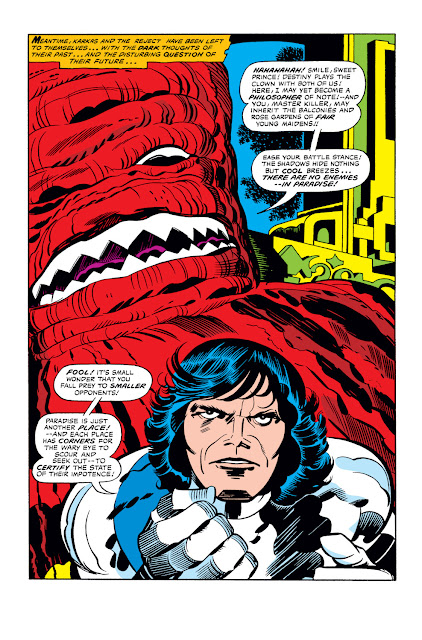
Again, like the Fourth World, The Eternals was not flawless. Kirby's dialog was stilted and odd, out step with the verbal style of the times, and lacking Stan Lee's sometimes purple and corny but nonetheless more naturalistic ear. Some readers couldn't and still can't stand it. His art, too, looked different. Without the leavening of Joe Sinnot or Vince Colleta's inks, which tended to pretty things up and smooth out the rougher edges, the Mike Royer-inked pages of The Eternals et al gave us Kirby unfettered. For some, it was too stylized, too strong. The dynamism was unquestionable, but Kirby's big square hands and homely faces were not what Marvel-ites expected, or were used to. To those who knew Kirby's art from the mid-60's, he seemed to have changed. Those who'd cut their teeth on Neal Adams and Jim Steranko wondered what all the fuss was about.
Yet focusing on these ignores the many strengths. Aside from concept, the characterization was some of the strongest of any Kirby solo title. While the human characters were little more than passive bystanders (its worth noting that, out of a large cast, only three of the characters were humans), several strong personalities emerged from The Eternals - especially the women - the powerful and noble Thena, and the playful and frequently cruel Sersi stand out. Likewise, there was the tricksterish Sprite, and the tragic and mysterious "hero" of issue # 13. Possibly the strongest and most complex was the Deviant general, Kro. Essentially a villain, yet Kro was driven by ambition, and capable of a certain flawed nobility and even love. In issue 8, "The City of the Toads", Thena, for whom Kro clearly has a major, and not entirely unrequited, crush, accompanies him to the Deviant city of Lemuria. There she is witness to the genocidal cleansing of mutated Deviants, accidents of birth even more monstrous than the already gloopy Deviant breed, and the gladiatorial games used to eliminate the stronger mutants. Disgusted, Thena takes her leave, accompanied by two of the gladiatorial "mutates" - The Reject, who's mutation is that he looks like a handsome human, and Karkas, who looks something like a swollen carrot with legs and a gash of a mouth. But the studly Reject is, in fact, a brutal killing machine, whereas Karkas is an articulate and sensitive soul. The two of them argued constantly. Finally, there were The Celestials themselves - towering giants who looked as much like colossi in ornamental armor as they did robots. Never given a word or thought balloon, they remained a complete mystery, both beautiful and terrible.

Editorial pressures got the better of the series in its last days. Forced to introduce some element of Marvel continuity - The Hulk made an appearance in the next two issues. Sort of. In actual point of fact, it wasn't really The Hulk, but rather a super-powered android built by a pair of Hulk-loving college students (again, The Hulk was treated as a seemingly fictional character). This was the nadir of the series. Things picked up a bit with the next stories, including a powerful mutant Deviant in NYC, and a duel between Ikaris' and his Loki-like cousin Druig that felt like a throwback to late-period Thor. The Celestials, once the real center of the book, seemed to fade to the back almost entirely, and The Eternals finally became a superhero series after all.
With The Eternals laid to rest, Kirby finished out his contract with the strange but interesting Devil Dinosaur and the odd superhero Mister Machine, before moving on to animation and his even odder work at Pacific. He would never attempt anything this ambitious again.
Re-reading The Eternals today, I find it a bit of a shame he never got to continue. Kirby
was way ahead of his time in his attempt to create a long-form comics novel - such a project is commonplace today. Conceptually, he was dealing with issues such as the origins of man and myths, man's place in the universe, and man's future - and suggesting there might not be much future for humankind, and earth. To an kid of 11 (my age when I first read the early issues), this was heady stuff. To a middle-aged dude with an arsenal of knowledge behind him unavailable in my youth - it's still heady stuff. Announcing his return to Marvel in 1976, Kirby had promised that whatever he did would "electrocute you in the mind". Still in his prime, as an artist, creator, and storyteller Kirby kept his promise. This was the kind of wild innovation that had marked the explosion of creativity that had been the Marvel Age of the 60's. But the Marvel-philes of the day just wanted him back drawing the FF and Thor. With Stan writing. They didn't know what they had.
As the early 70's dawned, the big thing in comics at the mo' was spookery. DC had brought in Joe Orlando to overhaul the moribund House of Mystery title, restoring it to its original format of chills. While horror comics had never completely gone away (Charlton and Gold Key had been published mild ghost stories for a decade), it was a long way from the halcyon EC days. HoM was revived as a somewhat watered-down version of what Jim Warren was doing with Creepy and Eerie. It worked - sales took off, and soon DC was flooding the stands with scary stories. Marvel, of course, took notice. Their first response, a series of anthology titles, didn't catch fire (though there were some excellent stories, some superior to what DC and Warren were doing, including adaptations of Ted Sturgeon, Robert Bloch, H.P. Lovecraft and Robert E. Howard). Almost all were cancelled or turned into reprint books within a couple years. Their next attempt was a slew of titles, seemingly inspired by the Universal monsters - thus, we got Tomb of Dracula, Werewolf By Night, The Living Mummy, and The Monster of Frankenstein.

Monster has to be one of the great frustrating losses of Marvel-dom. The first half-dozen issues, written by Gary Friedrich and drawn by the great-great-great Mike Ploog, stand as one of the best horror comics ever done. Ploog's art, heavily influenced by Will Eisner, with a touch of Ghastly Graham Ingels, never looked better. The first three issues were a perfect adaptation of Shelley's novel, depicting a monster that was simultaneously sympathetic and frightening. #4 picked up where Shelley left off, with the monster returning to 19th century Europe in search of surviving Frankensteins, leading into a decidedly effective werewolf story in #5 and a solid mad-scientist story in #6. Up to this point, Monster ranks as one of the best of Marvel's horror titles.
Unfortunately, the worm turned fast. Ploog left the title, and art reins were handed over to John Buscema, who graced it with the most phoned-in looking art I've ever seen from Big John (and I've seen my share of phoned-in Buscema jobs). The story, with Frankie encountering Dracula in the 19th century, should've been a classic. As it was, it was minor entertaiment - a nice 30's-40's Universal vibe, done in by Buscema's hackwork. At least Ploog would have brought it the kind of dripping atmosphere it needed. In this storyline, the formerly eloquent monster was robbed of his ability to speak, a major loss.
Friedrich helmed a couple more issues, with weak art by Buscema and then even weaker art by Bob Brown. The storyline had run out of steam anyway, with the monster fighting a succession of hunchbacked brutes and yet another (albeit saner) Frankenstein descendent showing up to no apparent purpose.

With number 12, Val Mayerik had taken over art, Doug Moench, trying to salvage something, the writing, and Frankie found himself frozen in ice and revived in the swingin' 1970's. Under this creative team, Monster (the mag was now retitled The Frankenstein Monster) essentially morphed into The Hulk, with teenage loser Ralph Caccone filling the Rick Jones role. A fairly creepy beastie known as The Jigsaw Creature turned up, and yet another descendant of Frankenstein entered the mix -Veronica von Frankenstein. So too did a crime ring called I.C.O.N. All of this was pretty schizophrenic, not at all in the Gothic horror mode appropriate for a Frankenstein title. Too, Mayerik was one of the odder 70's Marvel artist - his work tended to veer from effective to grotesque, often in the same panel.
As the series wound down, Frankie got his speech back. But his personality seemed completely different than the one established early in the title's run (said personality had long since disappeared, and the monster had been void for some time). Mayerik gave him a goofy look that suggested he wasn't taking the whole enterprise too seriously anyway. Not unwisely. The final issue (#18) featured Frankie and his new robot buddy fighting off a posse of dwarves under the command of Victoria von Frankenstein. Yes, yet another Frankenstein.
While this suggested a possible return to the Gothic nature of the early issues, it also suggested a schizophrenic book and an uncertain direction on Moench's part as to where he would turn next. We'd never know - the story ended there. A subsequent Frankenstein series, seemingly unconnected to Monster, ran in the b&w Monsters Unleashed for another couple years, also written by Moench and drawn (mostly) by Mayerik, but the stories were unmemorable. Moench simply didn't seem to be able to make anything interesting out of Shelley's monster.
Since then the monster has occasionally turned up, usually as a hulking, silent brute. It seems Marvel didn't have any better idea of what to do with him than the mortal world.


